 listicle
Benefits of 24 Hour Gym Access: Pros, Cons & Timing
Table of Contents
- Why 24 Hour Gym Access Changes Your Routine
- 24-Hour Gym Pros and Cons: What to Weigh Before You Join
- Best Time to Go to the Gym: Matching Workouts to Your Body Clock
- Working Out at Night: Safety, Sleep, and Recovery
- How to Choose the Right 24 Hour Gym Membership
- Building Consistency with a Flexible Workout Schedule
- Conclusion
- Frequently Asked Questions
Last Updated: October 18, 2026
Why 24 Hour Gym Access Changes Your Routine
The benefits of 24 hour gym access start with a simple shift: your schedule stops dictating your training.
Most gyms close by 10 p.m. and open at 5 a.m. If you work a 7 p.m. to 7 a.m. shift, that window never fits.
Below, we break down the real pros and cons, the best time to go to the gym for your body clock, and how to read the fine print before you sign anything.
24-Hour Gym Pros and Cons: What to Weigh Before You Join
A 24-hour gym trades staffing for access. That trade is worth it for some people and a poor fit for others. Here is the honest breakdown.
| Factor | Pros | Cons |
|---|---|---|
| Hours | Train at any hour, including overnight | No staff on site during unstaffed hours |
| Crowds | Off-peak hours are quiet and relaxed | Peak hours still get busy |
| Equipment | Shorter waits for machines and racks | Popular equipment may need maintenance checks |
| Membership | Often month-to-month options | Rules and fees hide in the fine print |
| Safety | Secure keycard entry limits access | You handle emergencies alone at 2 a.m. |
The Pros: Flexibility, Quiet Hours, and Equipment Access
Flexibility is the headline. A flexible workout schedule means you train when your energy is up, not when the doors happen to be unlocked. Early risers get a quiet 5 a.m. session.
Off-peak hours also solve the crowded gym problem. When you train at 11 p.m., you rarely wait for a squat rack or a bench. That cuts waiting time and lets you move through a workout routine without interruptions.
The Cons: Staffing Gaps, Safety, and Membership Fine Print
The biggest trade-off is what you give up when the lights are on but nobody is at the desk. During unstaffed hours, there is no one to spot you, fix a broken machine, or respond to an emergency.
Membership fine print matters too. Some 24/7 gyms limit access to certain membership tiers. Others charge for a keycard or fob. Before you join, confirm which membership options actually include round-the-clock entry.
Best Time to Go to the Gym: Matching Workouts to Your Body Clock
The best time to go to the gym is whenever you will actually show up consistently, and your body clock should guide the rest. But "whenever you can" is not a plan. Use a short decision framework instead of guessing.
A four-question framework for picking your window
Answer these in order, and the right slot usually falls out:
- When does your day actually allow it? Block the two or three windows you can defend three to four days a week, before work, lunch, after bedtime, or post-shift. If a window only works once a week, it is not your training slot.
- When is your energy highest? Most people feel strongest mid-morning or late afternoon. If you are a true night owl, your peak may land after 8 p.m. Match hard sessions to your energy peak and easy sessions to the troughs.
- When is the gym quietest? Crowd patterns are predictable: early morning (roughly 5-7 a.m.) and after-work (roughly 5-7 p.m.) are the busiest windows at most facilities. Mid-morning, early afternoon, and late evening are typically quieter. Tour the gym at your candidate time before committing.
- How does it affect your sleep? If a late session leaves you wired, shift it earlier or cap intensity. If an early session means cutting sleep to five hours, it is the wrong slot.
Matching the window to the person
- Early risers: Train before 7 a.m. The gym is quiet, equipment is free, and you start the day with the routine complete. The trade-off is that you need an earlier bedtime to protect sleep.
- Night owls: Train between 8 p.m. and midnight. You avoid peak-hour crowds and still get a full session. Keep intensity moderate if you have an early morning.
- Shift workers: Anchor your workout to the end of your shift, not the clock. A 7 a.m. post-shift session is your "evening", treat it that way for meals, wind-down, and sleep.
Sample off-peak week
A practical pattern many members use:
- Monday, 9 p.m., full-body strength session, quiet floor, no rack wait.
- Wednesday, 6 a.m., cardio and mobility before work.
- Friday, 10 p.m., accessory work and core, moderate intensity.
- Saturday, 8 a.m., longer session with a training partner or coach.
Time management is the real skill here. Pick a window you can defend three to four days a week, then protect it.
Working Out at Night: Safety, Sleep, and Recovery
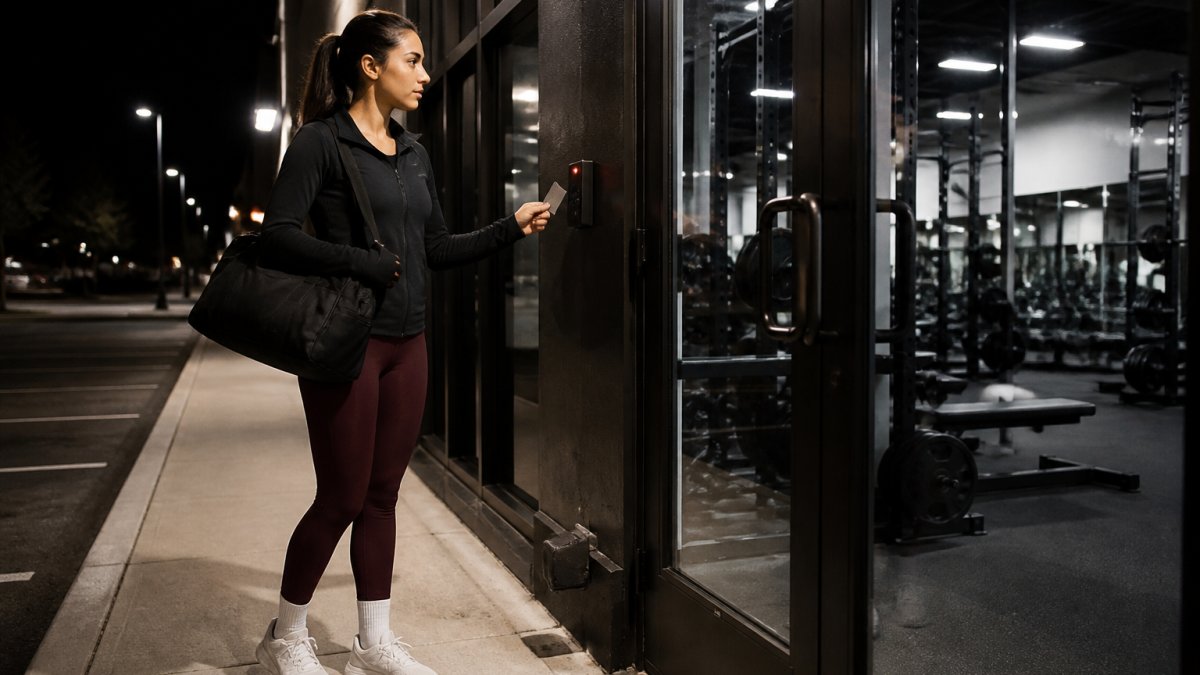
Night training works, but it demands a plan for safety and recovery. During unstaffed hours, you are your own safety net. The good news is that most 24-hour facilities build specific systems for exactly this situation, and knowing how they work is what separates a confident late session from a risky one.
How secure entry actually works after hours
Round-the-clock access is not an open door. Most facilities use one of three access-control setups:
- Keycard or fob entry tied to an active membership tier, with entry logs recorded electronically.
- Mobile app or Bluetooth entry that unlocks the door from your phone and timestamps each visit.
- PIN-code or biometric entry at facilities that want to eliminate lost-card risk.
Ask the front desk three questions before your first solo session: Does the system log every entry? Can staff see who is in the building remotely? And does my tier actually unlock the door at 2 a.m., or only during staffed hours? A common pattern is that overnight entry is restricted to higher membership tiers even when the gym advertises 24-hour access broadly.
Emergency systems to locate on your first unstaffed visit
Walk the floor once during daylight and map these before you need them:
- Emergency call stations or panic buttons, usually mounted near the front desk, locker rooms, and cardio areas. Confirm they connect to a monitored line, not just an in-house phone.
- AED and first aid kit locations, note whether the AED is in a cabinet that alarms when opened.
- Exits and stairwells, know the nearest one to wherever you train, not just the front door.
- Security cameras, most unstaffed facilities keep cameras recording and monitored remotely; ask who reviews footage and how quickly.
If an incident occurs, a fall, a dropped weight, a medical event, the sequence is simple: call 911 first if anyone is hurt, then use the emergency call station to alert the monitoring service, then stay with the injured person until help arrives. Do not move someone who may have a spinal injury. If you are alone and injured, get to the call station or your phone rather than trying to drive yourself.
Training alone without a spotter
Without staff on site, no one is watching your heavy set. Adjust accordingly:
- Use machines, cables, and dumbbells for maximum-effort work; save barbell bench and squat PRs for staffed hours or a session with a training partner.
- Set safety pins or spotter arms on any rack you use.
- Keep loads moderate on unfamiliar movements and leave one or two reps in reserve.
- Share your training schedule with someone at home and text when you arrive and leave.
Sleep and recovery: timing matters more than the clock
The CDC guidance on physical activity is clear that regular exercise supports sleep quality, but timing affects how well that holds. A hard session at 1 a.m. can push your bedtime back and hurt recovery if you have an early morning. Late-night lifters should keep intensity moderate, finish at least an hour before bed, and keep the post-workout wind-down calm, dim lights, no screens, a cool room.
How to Choose the Right 24 Hour Gym Membership
Choosing a membership comes down to five checks, in this order:
- Confirm your tier includes 24/7 access, in writing.
- Ask about keycard or fob fees and replacement costs.
- Read the cancellation policy and confirm there are no hidden fees.
- Tour the facility during the hours you will actually train.
At Year 20Fit, our memberships are month-to-month with no contracts and no cancellation fees, and 24-hour access is available for Gold and training members. That structure removes the long-term commitment that traps people in gyms they stop using. We also pair access with founder-coached small group and 1-on-1 training, so beginners are not left guessing.
The Federal Trade Commission's guidance on gym memberships is worth reading before you sign anything, especially on auto-renewal and cancellation terms.
Building Consistency with a Flexible Workout Schedule
Consistency is the whole game. A flexible workout schedule does not mean random workouts; it means a fixed routine with room to move when life interferes. Members who train at the same time most days build fitness motivation faster than members who improvise.
Our approach at Year 20Fit ties consistency to accountability. Every training plan includes personalized meal planning and body composition coaching, so the work inside the gym connects to results outside it.
Conclusion
The hardest part of fitness is not the workout; it is finding a schedule that survives a busy week. A 24-hour gym removes the hours problem, and the right membership removes the commitment problem. Year 20Fit offers no-contract, month-to-month memberships with 24-hour access for Gold and training members, founder-coached small group and 1-on-1 sessions, and training plans that include meal planning and body composition coaching.
Frequently Asked Questions
What are the benefits of 24-hour gym access?
The main benefits of 24 hour gym access include training on your own schedule, avoiding peak-hour crowds, and using equipment without long waits. Early risers, night owls, and shift workers can keep a consistent fitness routine even when work or family commitments change. Many 24-hour gyms also offer quieter workouts during off-peak hours and more flexible membership options. The key is choosing a facility with secure entry and clear staffed hours so you know what support is available when you train.
Are 24-hour gyms less crowded at night?
Yes, most 24-hour gyms see far fewer members during late-night and early-morning hours. Peak times typically fall before work (around 6-9 a.m.) and after work (around 5-8 p.m.). If you train after 10 p.m. or before 5 a.m., you will usually find more open equipment, shorter waits for machines, and a quieter environment. That said, exact traffic depends on the location and season, so visit during the hours you plan to use before committing to a membership.
Is it safe to work out at a gym late at night?
Safety at night depends on the facility. Look for secure keycard entry, well-lit parking, visible security cameras, and an emergency call system. Ask whether staff are on site during unstaffed hours and how incidents are handled. Train with a buddy when possible, tell someone your schedule, and keep your phone charged. A gym that clearly explains its safety measures and access limitations is a better choice than one that only advertises 24/7 access without details.
How can I stay consistent with a flexible gym schedule?
Consistency comes from planning, not motivation. Pick two or three fixed time slots each week that fit your work and sleep schedule, and treat them like appointments. Keep a bag packed and choose a gym close to home or work to cut travel time. Track your workouts so you can see progress, and adjust your plan when your shift changes rather than skipping sessions. A flexible workout schedule works best when you decide in advance which days are training days and which are rest days.