 how-to
Finding a Supportive Gym Community in Beltsville
Last Updated: October 23, 2026
Quick Summary
A supportive gym community is built on people who genuinely want to see each other succeed, with members acknowledging each other between sets, experienced lifters offering form tips, and staff knowing your name and goals. Finding one in Beltsville requires visiting during your actual workout time, asking specific questions about onboarding and coaching ratios, and assessing whether the culture welcomes beginners.
- One coach per 8 to 12 participants is a reasonable benchmark where form coaching matters
- Visit at the time of day you plan to work out, as community culture can feel completely different between 5 a.m. and 6 p.m.
- Ask the same eight questions at every facility and write answers down the same day for reliable comparison
- Month-to-month memberships let you try a gym without financial risk before committing long-term
- Small-group training bridges the gap between one-on-one sessions and anonymous group classes for beginners
Table of Contents
- What Makes a Gym Community Truly Supportive
- Questions to Ask Before Joining a Gym
- Small-Group Personal Training for Beginners
- Finding a Gym Workout Partner and Building Accountability
- Flexible Gym Access That Fits Your Schedule
- Assessing Gym Culture on Your First Visit
- No-Contract Memberships and Low-Commitment Options
- Conclusion
- Frequently Asked Questions
What Makes a Gym Community Truly Supportive
A supportive gym community isn't built on equipment or square footage, it's built on the people inside and how they treat each other.

The difference between a transactional gym and a community-driven one is obvious on your first visit: one feels like working out alone among strangers, the other like being part of something. That feeling keeps people consistent when motivation dips.
Questions to Ask Before Joining a Gym
Most gym tours are sales presentations. Treat the visit as an interview and ask the same questions at every facility so you can compare answers side by side.
1. New-member onboarding. Ask: "Walk me through my first two weeks.
**2.
**3.
**4.
**5.
6. Cost transparency. Ask for the total first-month cost, not the advertised rate: enrollment fee, last-month deposit, equipment or programming fees, and any class surcharges.
7. Accountability structures. Ask: "How do you help members stay consistent?" Look for progress check-ins, performance tracking, and a coach who knows your name and goals.
**8.
Local context to fold into the questions. Recreation departments and community centers in the area publish program guides with class schedules, drop-in rates, and session dates, and often run beginner-friendly group fitness and walking or running programs. When you call, ask whether the facility offers reduced-rate or trial programs and whether classes are included in membership or priced per session, those two answers can change the cost comparison significantly.
Use this checklist to compare gyms consistently across the key factors that predict whether you'll stay.
| Question | What to Listen For | Red Flag |
|---|---|---|
| New-member onboarding | Scheduled orientation, movement screen, named staff contact | Gym gives you a fob and you're on your own |
| Class size and coaching ratios | One coach per 8 to 12 participants | No answer about what happens when class is full |
| Modifications and beginner tracks | Specific substitutions and explanation of why | Every class follows one choreographed routine |
| Trial and drop-in policy | Free first class, discounted trial week, or drop-in rate | Trial is only a walk-through, not a real class |
| Membership terms and exit | Month-to-month option, 30-day notice period, pause option | Long-term contract with no buyout terms |
| Cost transparency | Total first-month cost including all fees | Only advertised monthly rate, no enrollment details |
| Accountability structures | Progress check-ins, performance tracking, coach knows your goals | Gym tracks nothing and has no retention mechanism |
| Community rituals | Member socials, partner workouts, small-group cohorts | Vague answer like we're like a family |
Small-Group Personal Training for Beginners
Small-group personal training bridges the gap between intimidating one-on-one sessions and anonymous group fitness classes. For beginners, it delivers expert coaching without the pressure of being the only person struggling.
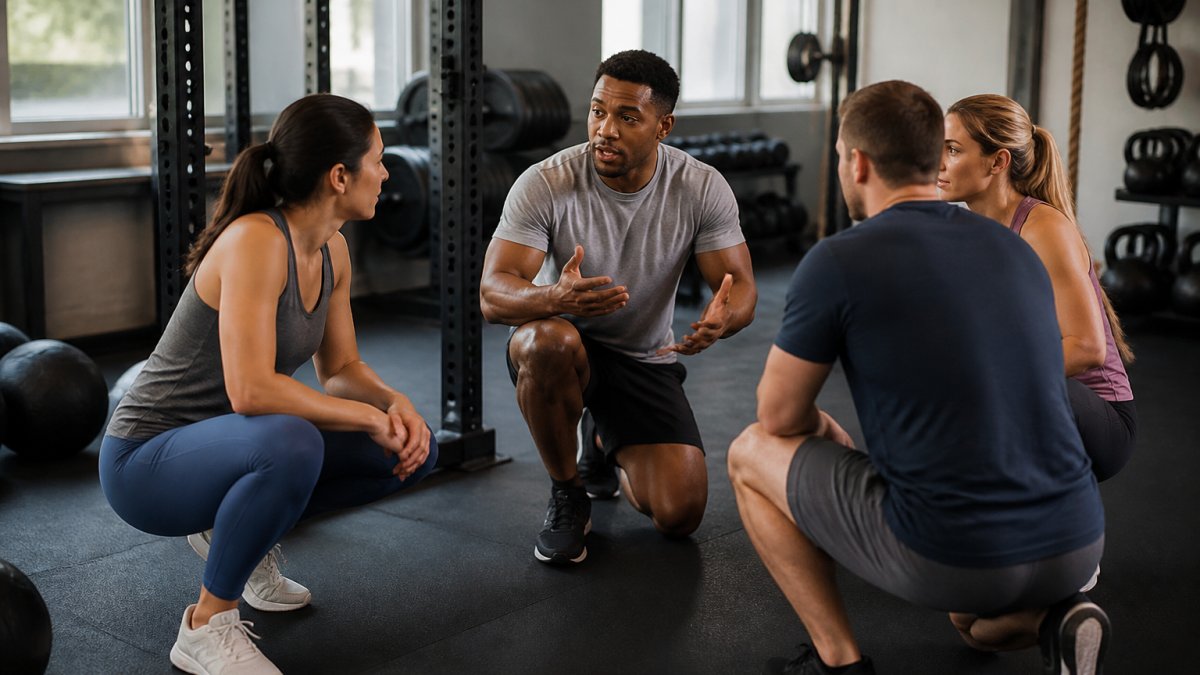
In a quality small-group setting, a trainer coaches 4-8 people through the same workout but offers individual form corrections and scaling options, a newer member does a modified version while a more advanced one adds weight. Everyone works toward their own goals in the same space, building camaraderie instead of comparison.
The key difference between effective small-group training and ineffective group classes is personalization. A trainer who knows your starting fitness level, injuries or limitations, and goals can adjust your workout on the fly, coaching you through progression, not just leading a choreographed class.
Many beginners worry they'll hold the group back or feel judged. That concern disappears when the trainer normalizes different fitness levels and the group culture celebrates effort over performance. A supportive gym community makes it clear that everyone starts somewhere.
Finding a Gym Workout Partner and Building Accountability
A workout partner transforms consistency from willpower into social commitment. When someone's expecting you at 6 a.m., you're far more likely to show up than when it's just you versus the snooze button.
The best workout partners aren't necessarily close friends, they're people with similar goals and compatible schedules. Many people want accountability too; they're just waiting for someone to suggest it. (Source: research on the psychological benefits of social support)
A supportive gym community makes this easier because the environment already encourages connection, member introductions, community events, or small-group training sessions where you naturally interact with others pursuing fitness.
Set specific expectations: which days you'll train together, what time, what you'll work on.
Year 20Fit's small-group training and flexible scheduling make it easy to find people training at times that work for you. Many members form lasting accountability partnerships through shared training sessions.
Flexible Gym Access That Fits Your Schedule
Shift workers, early risers, and people with unpredictable schedules often skip gyms because traditional hours don't match their reality. A gym that closes at 9 p.m. doesn't serve someone working nights.
24-hour gym access solves this constraint: you train when your body and schedule allow, not when the gym decides.
Beyond hours, flexibility also means no-contract memberships. Month-to-month options let you commit without financial pressure, if circumstances change or you need to pause, you're not locked into paying for months you won't use.
Flexible access plus a supportive gym community creates the conditions for real consistency: you train whenever you want, and when you show up, you're part of a community that keeps you engaged.
Assessing Gym Culture on Your First Visit
Culture is observable if you know what to watch for.
Staff behavior (watch the first 10 minutes). Does the desk person greet you by name after you introduce yourself? Does a coach introduce you to a member or another staff person? Does anyone ask about your goals or injury history before you touch equipment? A gym that skips introductions on a scheduled tour is showing you its default.
Member-to-member interaction. Watch for three things: members acknowledging each other between sets, an experienced member offering a form cue to someone newer, and someone welcoming a person who looks new. You don't need all three, but seeing none in 45 minutes is a signal. Note whether headphones are universal or people talk between sets, the pattern tells you what the room expects.
Coaching in action. Watch a class or small-group session for five minutes. Does the coach circulate to every participant or stay near the front? Offer modifications unprompted? Use names? A coach who corrects form and scales movements is doing the job; one who demonstrates once and counts reps is not.
Beginner accommodations. Ask to see where a true beginner would start. Look for a written onboarding sequence, a beginner class or intro session, and equipment that isn't all competition-grade.
The time-of-day test. Visit at the hour you'd actually train, a 5 a.m. crowd and a 6 p.m. crowd can feel like different gyms.
The follow-up test. After the visit, email or call with one specific question (for example, "What's the cancellation notice period, and can I pause for a two-week trip?").
Comparing local options side by side. Put several formats on the same shortlist: traditional gyms with group fitness, small-group training studios, recreation-department and community-center programs, and walking or running groups. For each, capture five data points, monthly cost including fees, class size, coaching ratio, trial terms, and the specific community ritual, in one spreadsheet row. That comparison is the step most gym searches skip, and the one that prevents a bad fit.
Beyond traditional gyms. If a standard membership doesn't fit, community-center fitness programs, drop-in yoga, and organized walking or running groups often provide the social accountability a gym does at lower cost and commitment.
No-Contract Memberships and Low-Commitment Options
Long-term contracts are how gyms lock in revenue from people who won't actually use them.
Month-to-month memberships let you try the gym without financial risk.
Some gyms offer trial periods, a free week or discounted first month. Use it to assess whether the supportive community is real and whether flexible access works for your schedule.
Year 20Fit's no-contract approach means you're never paying for a membership you've outgrown or that no longer fits your needs. Your commitment stays as strong as the community you're part of.
When evaluating pricing, remember the cheapest membership isn't the best value. A $10-per-month gym you never use costs more than a higher-priced gym where you actually train consistently.
Conclusion
Finding a supportive gym community in Beltsville starts with knowing what to look for and asking the right questions before you join. A truly supportive environment combines flexible access, expert coaching, and a culture where members genuinely support each other's progress. Year 20Fit is built on this foundation, offering month-to-month memberships with no contracts, 24-hour access for shift workers and early risers, and expert-led small-group training that includes personalized meal planning and body composition coaching. When you're ready to experience a gym community that keeps you consistent and celebrates your progress, book a free consultation with Year 20Fit and see how supportive gym community actually works.
Frequently Asked Questions
What questions should I ask before joining a gym?
Ask about class schedules, instructor qualifications, trial options, membership terms, cancellation policies, facility hours, and whether they offer small-group training. Inquire specifically about how they support beginners and whether the gym has a non-judgmental culture. Request to observe a class or meet with a coach before committing. These questions reveal whether the gym prioritizes community and genuine member success.
How do I know if a gym has a truly supportive environment?
Look for gyms where staff greet members by name, instructors modify exercises for different fitness levels, and members encourage each other rather than compete. Visit during peak hours to observe interactions. Ask current members about their experience. A supportive gym community emphasizes progress over perfection and celebrates all member achievements, regardless of starting point.
Are small-group personal training sessions good for beginners?
Yes. Small-group personal training combines expert coaching with the affordability of group classes. Instructors can provide individualized form corrections while you benefit from group motivation and accountability. This format works especially well for beginners because you're not alone, instructors scale exercises to your level, and you build connections with other members at similar fitness stages.
What makes flexible gym access important for shift workers?
Night-shift workers and early risers need 24-hour gym access to fit training into irregular schedules. Flexible hours remove the pressure to rush to the gym during set times and allow you to work out when you're most alert. This consistency, training at your natural peak hours, improves adherence and makes it easier to build a sustainable fitness routine regardless of your work schedule.