 how-to
7 Ways to Maintain Fitness on Night Shift
Last Updated: October 30, 2026
Quick Summary
To maintain night shift fitness, train before your shift starts after your main sleep block, when your body is warm and fed. Keep it simple with two full-body strength sessions per week of 30-45 minutes, protect your sleep, and plan meals and caffeine ahead.
- Two full-body strength sessions per week is a common starting point for maintaining strength.
- Train 1-3 hours after waking, before work, rather than after a long shift.
- Keep each set to 2-3 working sets of 6-12 reps and add weight or a rep when easy.
- After a 12-hour night shift, keep exercise light with a 20-minute walk or mobility work.
- Stop caffeine at least six hours before you plan to sleep.
Table of Contents
- Why Night Shift Fitness Feels So Hard (and What Actually Works)
- Build a Night Shift Workout Routine You Can Repeat
- The Best Time to Work Out on Night Shift
- Exercise After a 12-Hour Night Shift: Safe or Skip It?
- A Workout Schedule for Night-Shift Workers Across Rotating Patterns
- Meal Planning, Hydration, and Caffeine Timing on Overnight Hours
- Protect Sleep and Recovery So Training Sticks
- Book a Free Consultation at Year 20Fit
- Frequently Asked Questions
Why Night Shift Fitness Feels So Hard (and What Actually Works)
Night shift fitness fails for a simple reason: your body runs on a clock that your schedule ignores.
People do not lack motivation. They lack a plan built for their hours.
Here is what most guides get wrong: they hand you a daytime workout plan and tell you to squeeze it in. That rarely sticks.
What works is smaller and more flexible:
- Two strength sessions a week, not five
- Workouts timed to your shift, not the clock on the wall
- Sleep protected like an appointment
Below, we show you exactly how to maintain fitness on night shift with seven practical steps, including sample schedules for fixed, rotating, and graveyard shifts.
Build a Night Shift Workout Routine You Can Repeat
A repeatable night shift workout routine beats a perfect one you do twice. Consistency is the whole game.
Start with these rules:
- Pick fixed days, even if the times move
- Keep sessions to 30-45 minutes
- Train before work if you can, not after
If you want a deeper look at sticking with it, our guide on how to stay consistent with fitness covers the habits that keep a routine alive through schedule changes.
Two Sessions Per Week Is Enough to Maintain Strength
Two full-body sessions per week is a common starting point for maintaining strength, and it takes pressure off.
A simple two-day plan:
- Day A: squat or leg press, push-up or bench press, row, plank
- Day B: deadlift or hip hinge, overhead press, pull-down, carry
Keep each set to 2-3 working sets of 6-12 reps. Add a small amount of weight or one rep when the last set feels easy. Small gains add up over months.
The Best Time to Work Out on Night Shift
The best time to work out on night shift is before your shift starts, after your main sleep block. Your body is warm, you are fed, and the session will not eat into recovery.
Here is the practical order:
- Wake up and get light exposure
- Eat a real meal
- Train 1-3 hours later
- Shower, eat again, head to work
Training after a long shift can work too, but keep it short and light. Save heavy lifting for the pre-shift window.
How Circadian Rhythm Affects Workout Timing
Circadian rhythm is the body's internal 24-hour clock that controls sleep, temperature, and energy (Circadian Rhythms). Working nights pushes that clock later, a shift researchers call phase delay.
That matters for training because strength and energy follow your body clock, not the wall clock. The CDC guidance on shift work and long hours notes that shift workers face higher risks of sleep loss and fatigue, so timing matters more, not less.
Practical takeaway: train during your personal "morning," whenever that falls. If you want to understand how 24-hour access changes your options, see the benefits of 24 hour gym access.
Exercise After a 12-Hour Night Shift: Safe or Skip It?
Exercise after a 12-hour night shift is safe for most people, but keep it light. Think a 20-minute walk, easy cycling, or stretching and mobility work.
Skip heavy lifting after a rough shift. Fatigue raises injury risk and poor form shows up fast.
Watch out: pushing a hard session on four hours of sleep is how people tweak a back or drop a weight. If you feel foggy or shaky, choose rest.
Use a simple rule:
- Good energy: short strength session, moderate weight
- Average energy: cardio or mobility only
- Wrecked: sleep first, train tomorrow
A Workout Schedule for Night-Shift Workers Across Rotating Patterns
A workout schedule for night-shift workers should match your shift pattern, not a generic template. Fixed, rotating, and graveyard shifts each need a different layout. Below are three copyable weekly layouts plus a flexible two-day training plan you can run inside any of them.
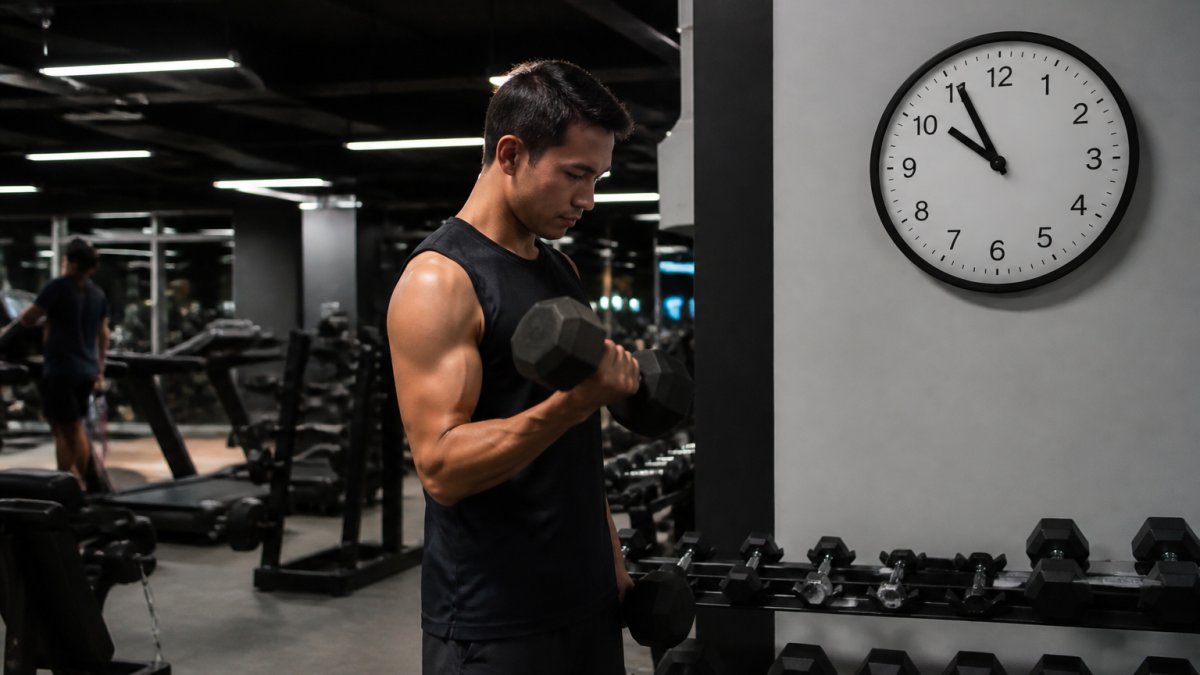
Sample Schedules for Fixed, Rotating, and Graveyard Shifts
| Shift Pattern | Best Training Window | Weekly Plan | Watch Out For |
|---|---|---|---|
| Fixed nights (e.g., 11pm-7am) | After waking, before work | 2 strength + 2 short walks | Skipping meals before training |
| Rotating shifts | Same days each week, flexible times | 2 strength + 1 cardio | Rebuilding routine after each flip |
| Graveyard (overnight, long) | Before shift on workdays | 2 strength on days off + mobility | Training while badly sleep-deprived |
| 12-hour shifts | Days off and light pre-shift work | 2 strength on off days | Back-to-back heavy sessions |
Fixed nights, hour by hour. If you work 11pm-7am, your main sleep block is roughly 8am-3pm. Wake at 3pm, get 10-15 minutes of outdoor light, eat a real meal by 4pm, and train 5-6pm.
Rotating shifts, anchor days. Rotating schedules are the hardest to program because your energy moves every week.
Graveyard and 12-hour shifts, protect the off days. When your shift runs 12 hours, trying to lift on workdays usually backfires.
A Flexible Two-Day Training Plan You Can Run on Any Shift
This plan assumes two full-body sessions per week, 30-45 minutes each, and works with dumbbells, machines, or bodyweight. Run Day A and Day B on non-consecutive days.
Day A
- Squat or leg press, 2-3 sets of 6-12 reps
- Push-up or bench press, 2-3 sets of 6-12 reps
- Row (dumbbell, cable, or band), 2-3 sets of 8-12 reps
- Plank, 2-3 sets of 20-40 seconds
Day B
- Deadlift or hip hinge (dumbbell or kettlebell), 2-3 sets of 6-10 reps
- Overhead press, 2-3 sets of 6-12 reps
- Pull-down or assisted pull-up, 2-3 sets of 8-12 reps
- Farmer carry, 2-3 sets of 30-40 seconds
Progression rule: when you hit the top of the rep range on your last set with clean form, add one rep next session.
High-fatigue day alternative: if you slept under five hours or feel foggy, run a 15-minute version, one set of each exercise at half your usual weight, plus five minutes of walking. You keep the habit without digging a recovery hole.
For a full 24-hour layout you can copy, see how to build a 24 hour gym night shift schedule. It walks through a week hour by hour.
Meal Planning, Hydration, and Caffeine Timing on Overnight Hours
Meal planning does more for night shift fitness than most people expect. Eating at random hours wrecks energy and makes training feel harder. The fix is not a strict diet, it is a repeatable timing pattern with a few go-to meals you can pack before your shift.
Keep it simple:
- Pack meals before your shift, not during it
- Build each meal around protein, vegetables, and a slow carb
- Avoid heavy meals in the last third of your shift
For a deeper plan that fits overnight eating, our personalized meal planning for weight loss guide breaks down portions and timing.
Nutrition Timing Across Overnight Hours
Eat your largest meal before your shift, a lighter meal mid-shift, and a small snack near the end. This keeps energy steady and limits late-shift junk food runs. A workable pattern for an 11pm-7am shift looks like this:
- Pre-shift (around 9-10pm): your largest meal, a palm-sized portion of protein (chicken, fish, eggs, tofu, or Greek yogurt), a fist-sized portion of vegetables, and a cupped-hand portion of a slow carb (rice, potatoes, oats, or beans).
- Mid-shift (around 2-3am): a lighter meal, a smaller protein portion with vegetables, or a bowl of soup with beans and greens.
- Late shift (around 5-6am): a small snack, a piece of fruit with a handful of nuts, or a protein shake, so you are not ravenous when you get home.
Hydration matters just as much. Keep a water bottle at your station and sip through the night. Hydration needs vary, so drink enough water to stay comfortable through your shift.
Caffeine has a cutoff. Have your last coffee early in the shift, ideally several hours before your sleep block, so it does not fight your rest. A practical rule is to stop caffeine at least six hours before you plan to sleep, for an 8am bedtime, that means no coffee after about 2am.
Protect Sleep and Recovery So Training Sticks
Sleep is the foundation of night shift fitness. Without it, training gains stall and motivation drops.
Protect your sleep block like a work meeting:
- Keep the room dark with blackout curtains
- Use earplugs or a white noise machine
- Keep the room cool
- Hold the same sleep window on days off where you can
Stretching and mobility work count as recovery. The National Sleep Foundation's guidance on shift work recommends a consistent sleep schedule and a dark, quiet room to support rest during daytime sleep.
Track your progress simply. Log workouts, sleep hours, and energy in a notes app. Look for trends over weeks, not days.
Book a Free Consultation at Year 20Fit
Building a night shift fitness plan is doable on your own. But a coach who knows your schedule can save you months of guesswork.
At Year 20Fit, we built our gym around people with odd hours. Our Gold and training members get 24-hour access, and we offer no-contract, month-to-month plans.
If you want a plan that fits your shift, book a one-on-one fitness assessment and we will map it out with you.
Frequently Asked Questions
Is it okay to work out after a 12-hour night shift?
Often yes, but intensity matters. After a 12-hour shift your coordination and energy are lower, so a short, moderate session (20-30 minutes of walking, mobility work, or light strength training) is usually safer than heavy compound lifts. If you feel dizzy, shaky, or unusually fatigued, skip the session and prioritize sleep. Listen to your body and keep hard training for days when you are rested.
When is the best time to exercise if you work night shift?
Most night-shift workers do best training either right before their shift (after a full sleep block) or shortly after waking, since that is when energy and body temperature are rising. Exercise right after a long shift works for some people but often leads to weaker sessions. Test a few windows over two weeks and keep the one you can repeat consistently, because consistency matters more than the perfect hour.
How many days a week should night-shift workers work out?
Two to three strength sessions per week plus daily movement is enough to maintain fitness and build small gains. Two sessions per week is the realistic minimum for busy shift workers, and it protects muscle and strength even during heavy work weeks. Add walking, stretching, or mobility work on other days. Rest days are part of the plan, not a failure.
How can I stay consistent with exercise while working nights?
Anchor workouts to a fixed time relative to your shift, not to the clock, and keep sessions short (30-45 minutes). Prep meals and gym clothes ahead of time, track your sessions, and use a 24-hour gym so access never blocks you. Plan around your sleep schedule and treat training as a non-negotiable appointment. Small, repeatable habits beat occasional long workouts.
Your schedule is not an excuse, and it is not a barrier either. It just needs a plan built for it. Get started with Year 20Fit and train on your hours, with coaching, meal planning, and 24-hour access that fit around your shift.